The Problem
Section 164(2), Section 182, Section 149... Director disqualification is 7 grounds. Quorum for Board is one-third or 2, whichever is higher. Income Tax return due date for companies is October 31. How do you remember hundreds of numbers without them blurring together?
Section 164(2), Section 182, Section 149... Director disqualification is 7 grounds. Quorum for Board is one-third or 2, whichever is higher. Income Tax return due date for companies is October 31. How do you remember hundreds of numbers without them blurring together?
Why Rote Memorization Fails
Your brain is not designed to remember arbitrary numbers. It evolved to remember meaningful stories, spatial relationships, and emotional events. Mnemonics work by attaching meaningless data (section numbers, rates, dates) to something your brain IS designed to remember.
🔬 Dual Coding Theory
Alan Paivio's dual coding theory shows that information encoded through both verbal AND visual/associative channels is recalled significantly better than information in a single channel. Mnemonics create a secondary encoding path — a story, image, or phrase — that dramatically improves recall of abstract data.
Alan Paivio's dual coding theory shows that information encoded through both verbal AND visual/associative channels is recalled significantly better than information in a single channel. Mnemonics create a secondary encoding path — a story, image, or phrase — that dramatically improves recall of abstract data.
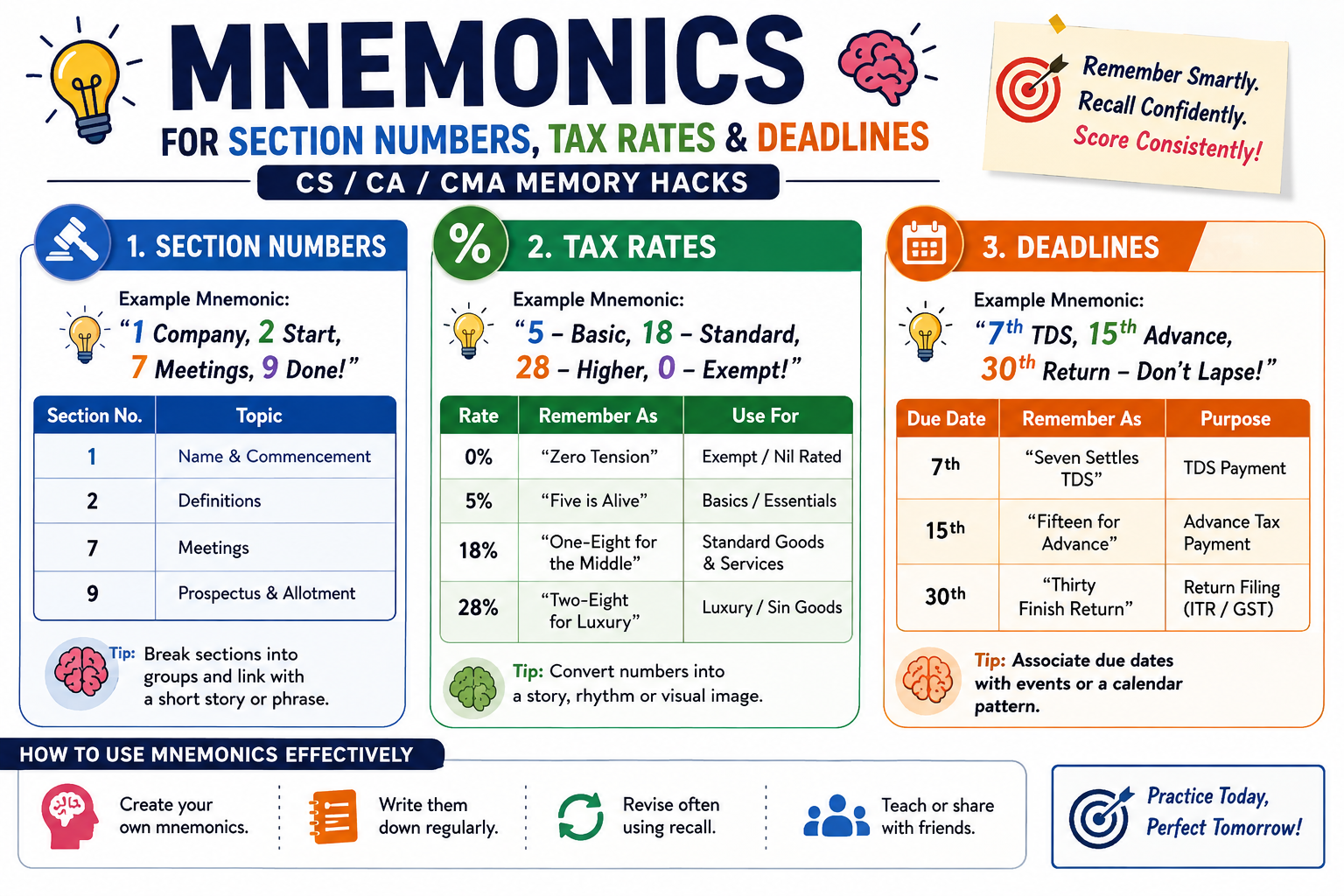
Mnemonic Techniques for Professional Exams
1. Acronyms
First letter of each item spells a word or phrase. Example — Director Duties under Section 166: Act in Good Faith, Promote Objects, Duties in Conflict, Not use Position → APDP (Act, Promote, Duties in conflict, Position misuse). Pair with section number.
First letter of each item spells a word or phrase. Example — Director Duties under Section 166: Act in Good Faith, Promote Objects, Duties in Conflict, Not use Position → APDP (Act, Promote, Duties in conflict, Position misuse). Pair with section number.
2. Sentence Mnemonics (First Letter)
Create a sentence where first letters spell the items. Example — 5 heads of income (Salary, House Property, Business/Profession, Capital Gains, Other Sources) → "Super Heroes Break Crime Often"
Create a sentence where first letters spell the items. Example — 5 heads of income (Salary, House Property, Business/Profession, Capital Gains, Other Sources) → "Super Heroes Break Crime Often"
3. Number-Shape System
Each digit has a shape (1=candle, 2=swan, 3=butterfly, 4=sail, etc.). Build a mini-story with those shapes to remember the number. Example: Section 182 → 1(candle) + 8(snowman) + 2(swan) → "A candle melted the snowman who swanned away" → Political contribution by companies.
Each digit has a shape (1=candle, 2=swan, 3=butterfly, 4=sail, etc.). Build a mini-story with those shapes to remember the number. Example: Section 182 → 1(candle) + 8(snowman) + 2(swan) → "A candle melted the snowman who swanned away" → Political contribution by companies.
4. Story Mnemonics
Turn the content into a brief story. Example: Director disqualification for non-filing (Section 164(2)) → "The director forgot to file returns for 3 years (numbers 1,2,3 in story), so the Ministry locked all 3 doors to his companies." Three strikes, locked out = all companies he's in are locked.
Turn the content into a brief story. Example: Director disqualification for non-filing (Section 164(2)) → "The director forgot to file returns for 3 years (numbers 1,2,3 in story), so the Ministry locked all 3 doors to his companies." Three strikes, locked out = all companies he's in are locked.
5. Chunking
Group numbers into patterns. Section numbers 160-167 are all about directors — study them as a "Director Chapter" cluster. 135 = CSR. Remember 135 as "CSR is 1 policy, 3% profit, 5-member committee."
Group numbers into patterns. Section numbers 160-167 are all about directors — study them as a "Director Chapter" cluster. 135 = CSR. Remember 135 as "CSR is 1 policy, 3% profit, 5-member committee."
Ready-to-Use Mnemonics
Key Mnemonics for CS/CA/CMA Students
5 Heads of Income (Income Tax): "Super Heroes Break Crime Often" → Salary, HP, Business, Capital Gains, Other Sources
Director Disqualifications (Section 164): "I Can't Be Free, No Mercy Given Today" → Insolvent, Convicted, Body Corporate, Found Guilty, Not filed returns for 3 years, Minor, Guilty of offences, Tribunals
GST Registration Threshold: "40 for goods, 20 for services" — picture 40 lorries carrying goods and 20 service-vans
Companies Act AGM — 21 days notice: "AGM = 3 weeks" (3 × 7 = 21) — picture 3 calendar weeks circled
Board Meeting — 7 days notice: "Board = 1 week" — one working week to call the board
5 Heads of Income (Income Tax): "Super Heroes Break Crime Often" → Salary, HP, Business, Capital Gains, Other Sources
Director Disqualifications (Section 164): "I Can't Be Free, No Mercy Given Today" → Insolvent, Convicted, Body Corporate, Found Guilty, Not filed returns for 3 years, Minor, Guilty of offences, Tribunals
GST Registration Threshold: "40 for goods, 20 for services" — picture 40 lorries carrying goods and 20 service-vans
Companies Act AGM — 21 days notice: "AGM = 3 weeks" (3 × 7 = 21) — picture 3 calendar weeks circled
Board Meeting — 7 days notice: "Board = 1 week" — one working week to call the board
💡 Building Your Personal Mnemonic Library
Don't rely only on others' mnemonics — self-created ones are more memorable because they use YOUR associations. For each difficult number or list, take 3 minutes to create your own mnemonic. Write it in a dedicated "Mnemonic Notebook." Review the notebook weekly.
Don't rely only on others' mnemonics — self-created ones are more memorable because they use YOUR associations. For each difficult number or list, take 3 minutes to create your own mnemonic. Write it in a dedicated "Mnemonic Notebook." Review the notebook weekly.
🎯 Mnemonic Workshop: 10 Minutes
Write down 5 section numbers or facts you always confuse. For each, spend 2 minutes creating ANY mnemonic — acronym, story, image, phrase. Quality doesn't matter at first. Just create the association. Test yourself after 10 minutes. Test again tomorrow. You'll keep 4 of 5.
Write down 5 section numbers or facts you always confuse. For each, spend 2 minutes creating ANY mnemonic — acronym, story, image, phrase. Quality doesn't matter at first. Just create the association. Test yourself after 10 minutes. Test again tomorrow. You'll keep 4 of 5.
- Mnemonic Notebook started (dedicated, not scattered)
- Acronyms created for all major multi-item lists
- Sentence mnemonics for most-tested provisions
- Number associations built for key section numbers
- Mnemonic review scheduled weekly (10 minutes)
- Self-created mnemonics prioritized over borrowed ones
🔑 Key Takeaway
Section numbers and dates are the ammunition of professional exams. A good mnemonic loads that ammunition into your memory in seconds. Build your mnemonic library systematically throughout preparation. By exam day, recalling Section 164(2) should feel as natural as remembering your own phone number.
Section numbers and dates are the ammunition of professional exams. A good mnemonic loads that ammunition into your memory in seconds. Build your mnemonic library systematically throughout preparation. By exam day, recalling Section 164(2) should feel as natural as remembering your own phone number.
Focus Duration vs. Learning Depth: Research Data
Conceptual Understanding Score by Average Session Focus Duration
Score on conceptual application questions | Source: Cal Newport deliberate practice research synthesis
The 60–90 minute window is the sweet spot for deep work on complex CA/CMA/CS material — where concepts connect, problems flow, and understanding deepens. Below 30 minutes, you're barely warming up. Above 90 minutes, diminishing returns set in and error rates increase.
Distraction Inventory: What's Killing Your Focus
| Distraction Source | Avg. Interruptions/Hour | Recovery Time per Interrupt | Fix |
|---|---|---|---|
| Phone notifications | 7–12 alerts/hr | 23 min full recovery | Phone in another room, DND on |
| WhatsApp/Social media | 4–8 self-checks/hr | 23 min full recovery | Time-blocked social: 2× daily only |
| Environmental noise | Variable | 5–10 min | Earphones + white noise / silence |
| Internal wandering (mind drift) | 8–15 episodes/hr | 3–5 min | Capture thoughts in a "distraction pad" |
| Switching between subjects | 2–4 switches/session | 15–20 min cognitive load switch | One subject per deep work block |
The 23-Minute Rule — Why Every Notification Costs You 23 Minutes
University of California Irvine researcher Gloria Mark found that after an interruption, it takes an average of 23 minutes and 15 seconds to fully return to the original task. A phone that buzzes just 3 times in a 3-hour study session steals over an hour of productive focus — even if you only glance at it for 5 seconds each time.
For CA Final students doing SFM or for CS students working through Complex Restructuring problems: these topics require sustained multi-step reasoning. A single notification during a complex calculation means you start that calculation over. The 23-minute rule is not an exaggeration — it's a laboratory measurement.
University of California Irvine researcher Gloria Mark found that after an interruption, it takes an average of 23 minutes and 15 seconds to fully return to the original task. A phone that buzzes just 3 times in a 3-hour study session steals over an hour of productive focus — even if you only glance at it for 5 seconds each time.
For CA Final students doing SFM or for CS students working through Complex Restructuring problems: these topics require sustained multi-step reasoning. A single notification during a complex calculation means you start that calculation over. The 23-minute rule is not an exaggeration — it's a laboratory measurement.
🎓 E-mentor for Deep Work Sessions
E-mentor's test questions require the same kind of focused application that the real exam demands. Practice taking E-mentor tests under zero-distraction conditions: phone off, 3-hour block, no interruptions. This trains your brain to maintain deep focus for exam-length durations. Students who routinely take E-mentor mocks in exam-conditions consistently report being more focused in the actual exam hall — because the focus muscle was already trained.
E-mentor's test questions require the same kind of focused application that the real exam demands. Practice taking E-mentor tests under zero-distraction conditions: phone off, 3-hour block, no interruptions. This trains your brain to maintain deep focus for exam-length durations. Students who routinely take E-mentor mocks in exam-conditions consistently report being more focused in the actual exam hall — because the focus muscle was already trained.
📎 Official Resources