The Problem
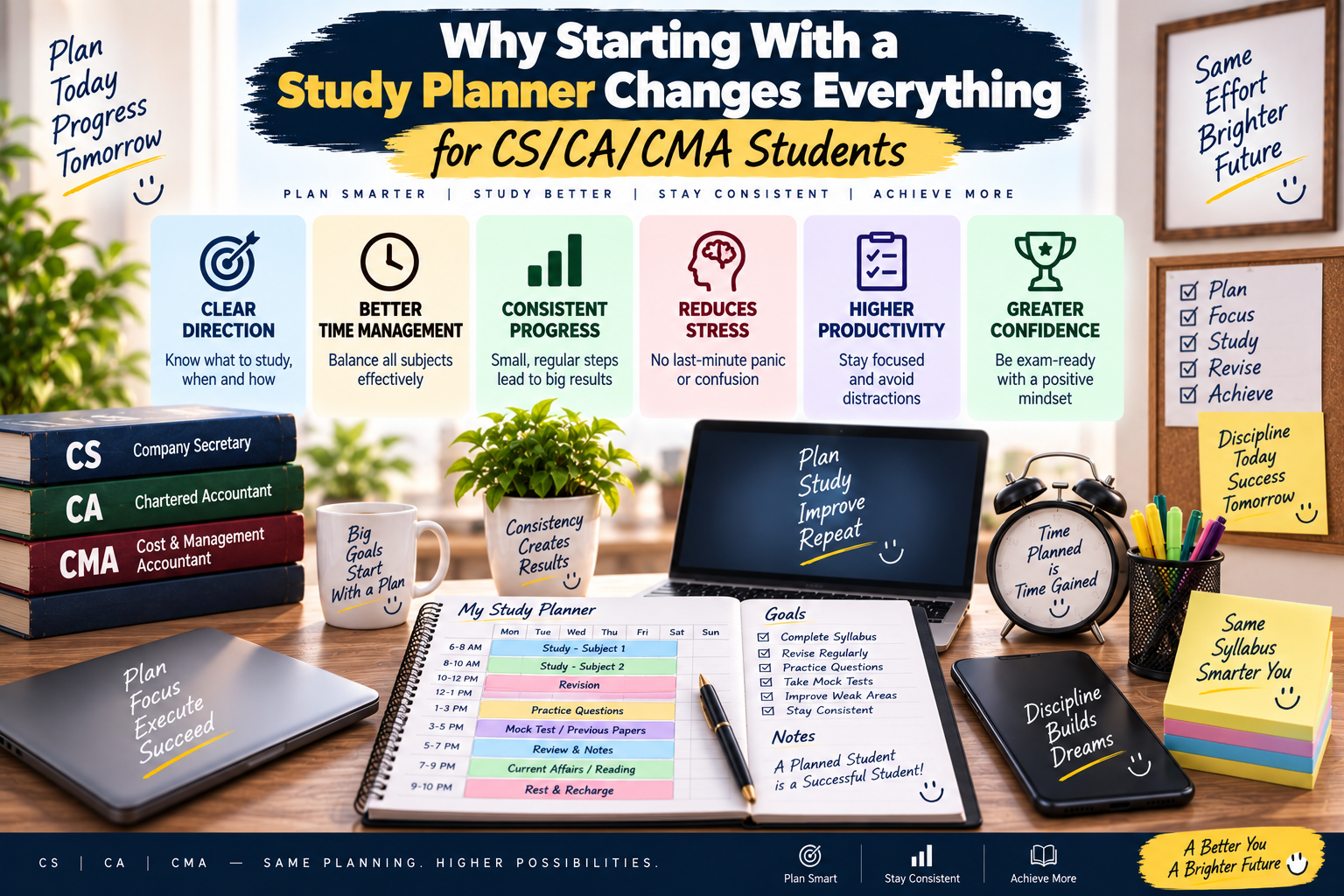
"I'll study everything eventually." Three months before CA Final, with 6 papers and 1,200 pages of content remaining, this plan meets reality — and reality wins. A study planner doesn't limit freedom. It creates it.
"I'll study everything eventually." Three months before CA Final, with 6 papers and 1,200 pages of content remaining, this plan meets reality — and reality wins. A study planner doesn't limit freedom. It creates it.
Why Most Students Never Start a Planner
Planning feels like procrastination — you're not actually studying. So students skip it and dive into content, creating the illusion of progress while drifting without direction. By the time they realize they're behind, it's too late to recover gracefully.
🔬 Goal Theory and Implementation Intentions
Research by Peter Gollwitzer (NYU, 1999) on "implementation intentions" found that people who specified WHEN, WHERE, and HOW they would accomplish goals were 3× more likely to complete them than those with vague intentions. A study planner is an implementation intention machine.
Research by Peter Gollwitzer (NYU, 1999) on "implementation intentions" found that people who specified WHEN, WHERE, and HOW they would accomplish goals were 3× more likely to complete them than those with vague intentions. A study planner is an implementation intention machine.
The 4-Stage Study Planner Framework
Stage 1: Audit (Day 1)
List every subject, every chapter, every topic. Count total pages. Identify weak areas vs. strong areas. This is your inventory.
List every subject, every chapter, every topic. Count total pages. Identify weak areas vs. strong areas. This is your inventory.
Stage 2: Allocation (Day 1–2)
Assign study hours per subject based on: marks weightage, personal weakness, complexity. Subjects you fear get MORE time, not less.
Assign study hours per subject based on: marks weightage, personal weakness, complexity. Subjects you fear get MORE time, not less.
Stage 3: Scheduling (Day 2)
Place allocated topics into specific calendar slots — date, time, duration. Not "Week 3 — Accounts" but "Oct 15, 9am–12pm — Consolidation Chapter 5–7."
Place allocated topics into specific calendar slots — date, time, duration. Not "Week 3 — Accounts" but "Oct 15, 9am–12pm — Consolidation Chapter 5–7."
Stage 4: Review (Weekly)
Every Sunday: review progress, adjust forward plan. Life happens — the plan adapts. Don't abandon the planner because one week went wrong.
Every Sunday: review progress, adjust forward plan. Life happens — the plan adapts. Don't abandon the planner because one week went wrong.
CA Final 6-Month Planner Template
💡 Allocation Logic for CA Final
Total study hours needed: ~800–1000 hours for a first-attempt pass
6 months × 26 study days × 6 hours/day = 936 hours available
Suggested allocation:
SFM: 150 hours (complex, high marks)
Advanced Accounts: 160 hours
Auditing: 100 hours
Law: 100 hours
Tax: 130 hours
Costing + MIS: 140 hours
IT + SM: 80 hours
Buffer + Revision: 76 hours
Total study hours needed: ~800–1000 hours for a first-attempt pass
6 months × 26 study days × 6 hours/day = 936 hours available
Suggested allocation:
SFM: 150 hours (complex, high marks)
Advanced Accounts: 160 hours
Auditing: 100 hours
Law: 100 hours
Tax: 130 hours
Costing + MIS: 140 hours
IT + SM: 80 hours
Buffer + Revision: 76 hours
📋 Audit all subjects — list every chapter
↓
⚖️ Allocate hours: weakness + marks weightage
↓
📅 Fill calendar with specific daily targets
↓
📊 Track completion daily (% done)
↓
🔄 Weekly review — adjust remaining plan
The Buffer Rule
⚠️ Critical: Always Build 20% Buffer
Never plan at 100% capacity. Life — illness, family events, bad study days — will consume 15–20% of planned time. Students who plan at 100% hit their first crisis and the whole plan collapses. Plan at 80%, and those lost days don't derail you. Your buffer saves the plan.
Never plan at 100% capacity. Life — illness, family events, bad study days — will consume 15–20% of planned time. Students who plan at 100% hit their first crisis and the whole plan collapses. Plan at 80%, and those lost days don't derail you. Your buffer saves the plan.
❌ No Planner Approach
- Study what feels interesting today
- Avoid weak subjects (anxiety)
- Realize 4 subjects untouched 3 weeks before exam
- Panic revision — shallow coverage
- Unpredictable performance
✅ With Planner
- Every subject scheduled equitably
- Weak subjects given more time early
- Full syllabus covered with buffer time
- Planned revision cycles (not panic revision)
- Consistent, predictable output
🎯 Start Your Planner in 20 Minutes
Open a spreadsheet (or paper). Column 1: Subject. Column 2: Chapters. Column 3: Hours needed. Column 4: Start date. Column 5: End date. Fill in all subjects. Don't perfect it — a rough planner beats no planner every time.
Open a spreadsheet (or paper). Column 1: Subject. Column 2: Chapters. Column 3: Hours needed. Column 4: Start date. Column 5: End date. Fill in all subjects. Don't perfect it — a rough planner beats no planner every time.
- All subjects listed with chapter counts
- Hours allocated based on weightage and weakness
- 20% buffer built into every week
- Specific daily targets (not just weekly goals)
- Weekly review scheduled (Sunday 30 minutes)
- Revision cycles planned (not just first-pass study)
- Mock test dates blocked out in advance
🔑 Key Takeaway
A study planner is not a luxury — it's the difference between attempting and passing. Every hour spent planning saves 5 hours of panicked catch-up. Build your planner today. It takes 30 minutes. It will repay those 30 minutes a hundredfold.
A study planner is not a luxury — it's the difference between attempting and passing. Every hour spent planning saves 5 hours of panicked catch-up. Build your planner today. It takes 30 minutes. It will repay those 30 minutes a hundredfold.
Hours Required: CA Final vs. CS Professional vs. CMA Final
Estimated Study Hours Required Per Subject (First Attempt Pass)
CA Final estimated hours based on topper survey (n=50) — individual variance applies
The 6-Month Planner: Complete Template
| Month | Phase | Primary Activity | Weekly Hours | Testing | Key Milestone |
|---|---|---|---|---|---|
| Month 1 | Coverage | Group 1 subjects first pass | 35–38 hrs | Chapter tests only | 50% Group 1 covered |
| Month 2 | Coverage | Complete Group 1 + begin Group 2 | 35–38 hrs | Topic tests weekly | Group 1 complete |
| Month 3 | Coverage | Complete Group 2 + first revision G1 | 38–40 hrs | 1 mock per Group 1 subject | Full syllabus first pass |
| Month 4 | Depth | Weakness attack + deep revision | 40 hrs | 2 mocks per subject | All weaknesses addressed |
| Month 5 | Mock Blitz | Full mock exams + targeted revision | 35 hrs | 8 full mocks total | Consistent 55%+ in mocks |
| Month 6 | Peak + Rest | Final revision + 2 mocks per subject | 30 hrs | Last 2 mocks per paper | Confident, rested, ready |
Planning Failures: The Most Common Reasons
| Planning Mistake | Why It Fails | The Fix |
|---|---|---|
| Studying favourite subjects first | Weak subjects stay weak until last 30 days | Schedule weak subjects in Morning Block 1 |
| No buffer days | One illness collapses the entire plan | Plan at 80% capacity — 1 buffer day/week |
| Planning study without revision | Month 1 content forgotten by Month 4 | Build revision cycles INTO the plan from Month 2 |
| Overly detailed daily schedules | One day off and "the plan is broken" | Weekly targets, flexible daily execution |
🎓 E-mentor's Role in Your Study Plan
Integrate E-mentor test series dates directly into your study plan. After completing each subject's first pass (Month 1–3), schedule the E-mentor mock for that subject. After your weakness attack phase (Month 4), schedule another full mock. This forces plan adherence — your E-mentor test date is a commitment device that keeps you on track. The test also provides the data to adjust your Month 4–5 revision priorities. Plans without accountability drift; plans anchored to test dates don't.
Integrate E-mentor test series dates directly into your study plan. After completing each subject's first pass (Month 1–3), schedule the E-mentor mock for that subject. After your weakness attack phase (Month 4), schedule another full mock. This forces plan adherence — your E-mentor test date is a commitment device that keeps you on track. The test also provides the data to adjust your Month 4–5 revision priorities. Plans without accountability drift; plans anchored to test dates don't.